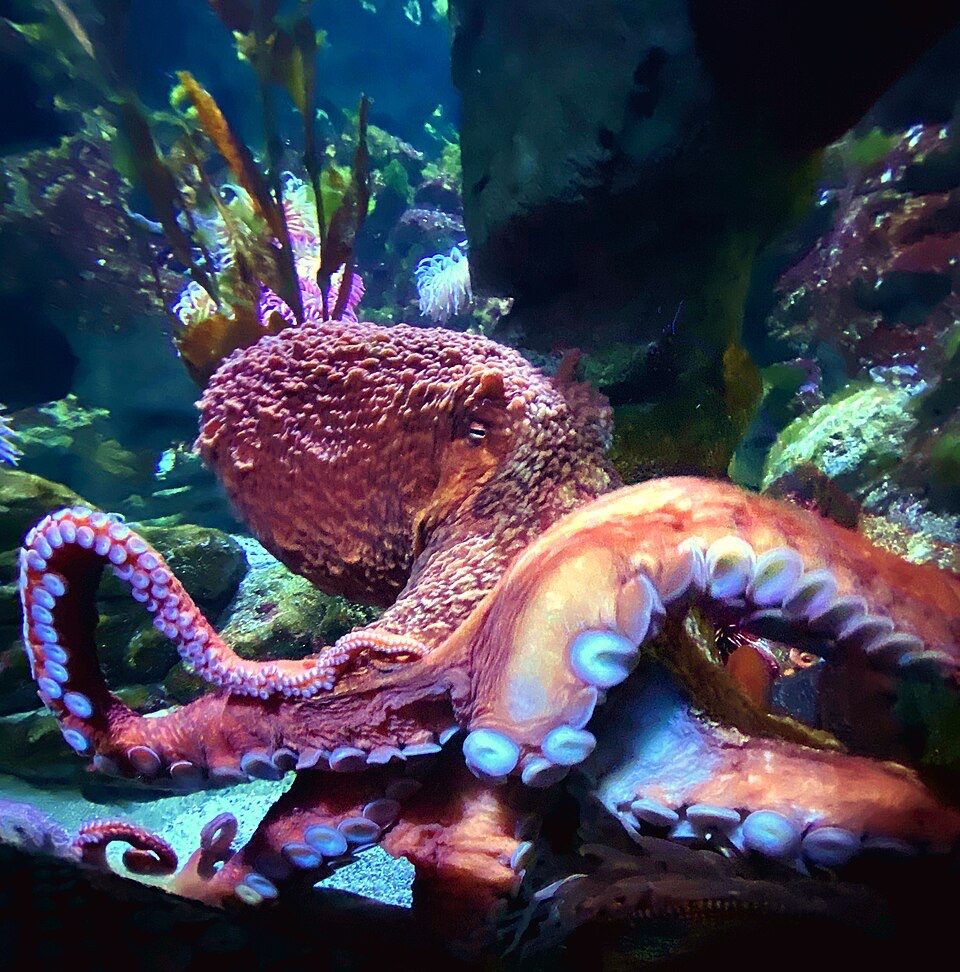
Octopuses for kids
Octopuses are clever, soft-bodied sea animals with eight arms covered in suckers. They are molluscs, related to squid and cuttlefish, and there are about 300 kinds. An octopus has three hearts, blue blood and no bones, so it can squeeze through tiny gaps; the only hard part is its beak.
Octopuses live in every ocean, from rock pools to the deep sea. They can change colour in an instant to hide, squirt a cloud of ink to escape, and even taste things with their suckers.
Fun facts
- Three heartsTwo pump blood through the gills and one pumps it around the body.
- Blue bloodOctopus blood is blue because it contains copper.
- Arms, not tentaclesScientists call an octopus’s eight limbs arms.
- Tasting with armsThe suckers can taste what they touch.
- Squeezy!With no bones, only the beak limits the size of gap it can fit through.
- Coconut homesThe veined octopus carries coconut shells to hide in.
- Escape artistsOctopuses have escaped from aquarium tanks.
- CopycatThe mimic octopus pretends to be a lionfish or a sea snake.
Key words
- suckers
- round cups on the arms that grip, taste and smell
- beak
- the hard mouth, the only hard part of an octopus
- ink
- a dark cloud squirted to confuse predators
- siphon
- a tube that squirts water so it can move fast
- mantle
- the bag-like body behind the head
- camouflage
- changing colour and texture to blend in
- invertebrate
- an animal with no backbone
- cephalopod
- the group with octopuses, squid and cuttlefish
For older children and teens
Body and senses
- Octopus blood uses haemocyanin, a copper-rich protein that carries oxygen well in cold water with little oxygen.
- An octopus has about 500 million neurons, as many as a dog, and two-thirds are in its arms.
- Skin cells called chromatophores let it change colour, and tiny muscles change its skin texture.
Behaviour and intelligence
- Octopuses solve puzzles, find their way through mazes and remember what they learn.
- Carrying coconut shells to build a shelter counts as tool use.
- Some octopuses seem to recognise individual people.
Octopuses and people
- Octopuses appear in myths, such as the kraken sea monster.
- From 1993 the common octopus was the only invertebrate protected under UK law on animal experiments; since 2012 that covers all cephalopods.
- Engineers study octopus arms to build soft robots that can grip and move objects.